


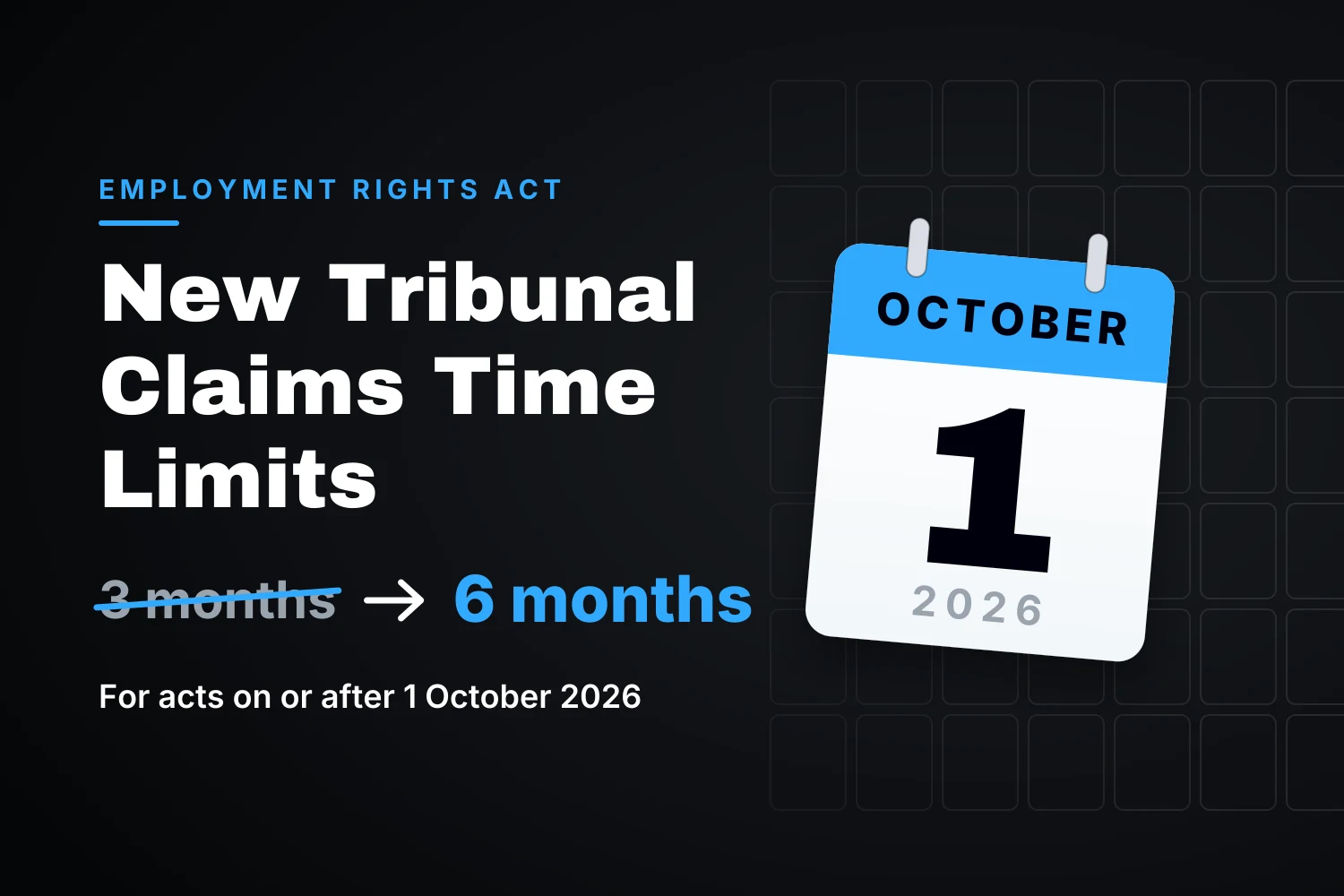
Employment Tribunal Claims Time Limits 1st October 2026
Three more important sections of the Employment Rights Act 2025 come into force in October 2026, namely:
- Time limits to submit your employment tribunal claim increase from three months (less one day) to six months (less one day). Effective 1st October 2026
- Sexual harassment: Employers must take “all reasonable steps” to prevent sexual harassment. They also become liable when customers or clients harass their staff. From 30th Oct 2026
- Trades unions access: Your employer must give you a written statement of your right to join a trade union, and unions get a right of access to workplaces. From 30th Oct 2026
As the time limit for submitting an employment tribunal claim is soonest and also critically affects every individual who has a claim, we’re focusing on time limits in this blog.
We cover the sexual harassment changes in our post ‘Sexual harassment at work: new protections from 30th October 2026‘.
Six months to bring a tribunal claim from 1st October 2026
For over fifty years, the deadline for most employment tribunal claims has been three months less one day from the act you’re complaining about. Miss the deadline and you’ve lost your right to claim, no matter how strong your case.
From 1st October 2026 that changes. The Employment Rights Act 2025 doubles the time limit for most claims. That’s good news for employees, but there’s a catch that’s likely to trip people up over the next few months: the new limit isn’t backdated.
What exactly is changing?
Under section 152 of the Employment Rights Act 2025, the time limit becomes six months less one day. It applies to the most common tribunal claims, including:
- unfair dismissal
- discrimination and harassment
- unlawful deductions from wages, including holiday pay
- whistleblowing and other detriment claims
- breach of contract claims when your employment ends.
A few claims already had a six-month limit and don’t change, including statutory redundancy pay and equal pay.
The catch: the new limit isn’t backdated
The new limit applies only where the act you’re complaining about happened on or after 1st October 2026. Anything earlier keeps the three months less one day deadline, even if you only take advice after 1st October.
A claim that’s already out of time doesn’t come back to life. So, if you were dismissed on 20th September 2026, your deadline is 19th December 2026, not March 2027.
Don’t fall into the trap of reading that tribunal time limits are now six months and assuming that you actually have longer than you do.
Which date counts?
Which date counts depends on the type of claim:
For unfair dismissal and breach of contract: it’s your last day of employment, not the day you were told you were going to be dismissed.
So:
- If you’re given notice in September and your employment ends in October, you get six months to make a claim.
- If you’re paid in lieu of notice and your employment ends straight away in September, you get three months.
- For deductions from wages: it’s the date of the payment the deduction came out of, or, if there’s been a run of deductions, the last one.
- For discrimination: it’s the date of the act or, where the conduct has gone on over a long period, the end of that period.
What if the treatment started before 1st October and carried on after?
This is where it gets tricky. If you’ve been subjected to discriminatory conduct that has gone on over a period, or to a series of detriments or deductions, what counts is the end of the period or the last act in the series.
If that falls on or after 1st October 2026, the six-month limit covers the whole claim, including the incidents before October.
But that’s only if it really is one continuing pattern. If the tribunal decides the earlier incidents were one-offs, each is judged against the three-month limit, and they may already be out of time.
This means one claim can end up with some parts on the three months limit and others on six: for example, a one-off discriminatory remark in September, may be followed by a dismissal in November.
Failures to make reasonable adjustments for a disability need particular care. Time runs from when your employer is treated as having decided not to make the adjustment, which may be well before October, even if the problem is still going on.
You still have to go to Acas first
You must still notify Acas before you can bring a claim, and you have to do it within your time limit. Early conciliation extends the deadline, but only if you start it in time. (See our guide on early conciliation for the timings you have to observe for that process.)
The tribunal can still allow some claims in late, where it’s “just and equitable” for discrimination or where it wasn’t “reasonably practicable” to claim in time for most other claims. Those powers are used sparingly, so don’t plan around them.
Six months isn’t a reason to wait
Six months may seem like a long time, and it’s certainly an improvement on three months. But it’s not an invitation to sit on it and delay taking action. Witnesses move on, memories fade, and documents are much easier to get hold of while you’re still on the payroll.
What you should be doing now
- Check your dates. Work out when the act you’re complaining about happened. If it was before 1 October 2026, you’re on the three months (less one day) claim time clock.
- Look at each complaint you may be making separately. Different complaints in the same claim can have different deadlines.
If in doubt, assume three months. Working to the earlier date costs you nothing. Getting it wrong can cost you the entire claim. - Keep a record. Dates, times, who was there and what was said, plus copies of emails and documents while you can still get hold of them.
- Take advice early. It’s rarely too early to seek legal advice, and your options narrow as time passes.
For more detail, see our guides on tribunal time limits and the types of claim you can bring, and our round-up of the Employment Rights Act 2025.
FAQs about Tribunal claim time limits
Do I now have six months to bring any tribunal claim?
Most claims, yes, from 1 October 2026. That includes unfair dismissal, discrimination, and unlawful deduction from wages. A few claims already had a six-month limit, including equal pay and redundancy.
My manager’s treatment of me started in summer 2026 and is still going on. Which limit applies?
If it’s one continuing course of conduct that carries on past 1st October 2026, the six-month limit can cover all of it. Whether it counts as continuing is for the tribunal to decide, so the safe course is to act within three months of the earliest incident you want to rely on.
Has the time limit for redundancy pay changed?
No. Claims for a statutory redundancy payment already had six months, and that stays the same.
Does the six-month limit apply to something that happened in September 2026?
No. It applies only where the act you are complaining about happened on or after 1 October 2026. For anything earlier the deadline is still three months less one day.
Need legal help?
If you think your employer is breaching your rights under the Employment Rights Act 2025, or in any other way, Monaco Solicitors may be able to help.
We are specialist employment lawyers and we act for employees only. Get in touch:
- Contact us online
- Phone 020 7717 5259
- Email [email protected]