




Unfair dismissal: why the qualifying period matters
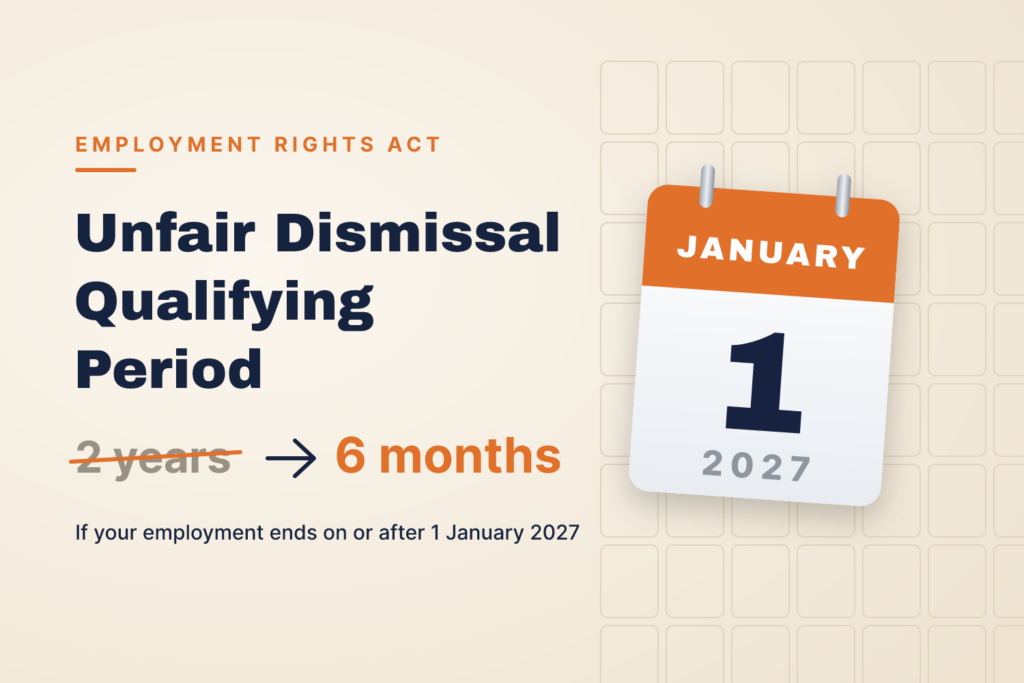
To claim ordinary unfair dismissal, you need to have worked for your employer for a minimum period. That period is two years, or six months if your employment ends on or after 1st January 2027.
Do I Have a Case?
Get an instant, free Case Analysis with strengths, weaknesses and next steps. From our award winning Monaco Solicitors AI.
Get Started
Verified Customer
“They certainly know their stuff and I would highly recommend. Using them certainly went in my favour.”
Verified Customer
Monaco Solicitors have been absolutely brilliant dealing with an employment issue I had, they…”
Verified Customer
“Better than expected. Professional and trustworthy with their advice.”
Verified Customer
“Monaco Solicitors delivered exceptional and professional legal support throughout. Their team…”
Verified Customer
“I can’t fault the friendly and professional service I received from Anca and Sundeep.”
Verified Customer
“Helpful, efficient, fully transparent and friendly. Exactly what you need when dealing with a difficult situation…”
Verified Customer
“A great service all round, my communications with all involved were excellent. Expertise were clear…”
Verified Customer
“Helen has handled my case exceptionally well. The quality of service, advise and communication…”
Verified Customer
“Very professional and courteous service. They were able to negotiate a higher settlement than initially…”
Verified Customer
“They certainly know their stuff and I would highly recommend. Using them certainly went in my favour.”
Rated 4.8 Stars in Over 1,000 Reviews
There are exceptions to this rule. If your claim is about discrimination, whistleblowing or a health and safety issue at work, for example, you don’t need any minimum period of service to bring an employment tribunal claim.
Have you worked for your employer long enough?
Before you start to think about whether you might have a legal employment claim, there is one basic question to answer: how long have you worked for your employer?
With some important exceptions, if you haven’t worked there long enough, your employer can dismiss you by giving you no more than your statutory or contractual notice. There is usually very little you can do about it.
The minimum period that you have to work for an employer is also called the ‘qualifying period’.
What is the qualifying period?
For many years the qualifying period has been two years’ continuous employment. The Employment Rights Act 2025 cuts it to six months providing that your employment ends on or after 1st January 2027.
That is the case even if your employer gave you notice before that date. So:
- if your employment ended on or before 31st December 2026, you need two years’ continuous service.
- But if your employment ends on or after 1st January 2027, you only need six months’ continuous service.
The qualifying period applies to ordinary unfair dismissal, which is the most common claim leading to settlement agreements. It also applies to constructive unfair dismissal.
How is your service counted?
Your service runs from the day you started work up to the day your employment ends.
If your employer dismisses you without notice, or with less than the statutory minimum notice, the statutory notice you should have had is added on when working out whether you qualify.
For anyone with less than two years’ service, the statutory notice is one week.
So if you were dismissed just short of six months (or, before 2027, just short of two years), don’t assume you’re out of time to qualify.
What else changes on 1st January 2027?
The cap on unfair dismissal compensation is abolished for dismissals where your employment ends on or after 1st January 2027. Our guide to unfair dismissal settlements and compensation explains what that means.
You will also be able to ask your employer for written reasons for your dismissal once you have six months’ service, rather than two years.
One thing doesn’t change: you still need two years’ service to get a statutory redundancy payment.
Our post on new unfair dismissal rights from January 2027 has more on what the change means for you.
Claims that need no minimum service
There are some important exceptions to the qualifying period, including the following:
Discrimination
If you’ve been discriminated against at work, you don’t need any minimum period of service before you can bring a discrimination claim against your employer.
Whistleblowing
If you are dismissed because you blew the whistle on wrongdoing at work, that is ‘automatically unfair dismissal’, and you can claim, no matter how long you have worked there. Our guide on whistleblowing explains more.
Dismissal due to fears about health and safety at work
You do not need any kind of health condition, or any minimum service, to claim ‘automatically unfair dismissal’ under section 100 of the Employment Rights Act 1996.
You would be automatically unfairly dismissed if, for example, you were dismissed for refusing to attend your workplace because you believed it posed a serious and imminent danger to your health and safety.
Pay cuts or other penalties related to health and safety issues at work
Similarly, you may suffer so-called ‘detriments’ (penalties or punishments) such as pay cuts or bullying for refusing to attend, or for deciding to leave, what you consider to be an unsafe workplace.
In those circumstances, you again don’t need any minimum service to bring a claim to an employment tribunal under section 44 of the Employment Rights Act 1996.
Our article on unfair dismissal, pay cuts, bullying and health and safety issues at work explains these health and safety rights in more detail.
Other automatically unfair reasons
Other reasons for dismissal that are automatically unfair, with no minimum service, include pregnancy and maternity leave, and asserting a statutory employment right (for example, asking for the minimum wage or your holiday pay).
Our guide on unfair dismissal tells you more about automatically unfair dismissal.
Cases where we may still be able to help
Monaco Solicitors have negotiated very high-value settlements for people without enough service who don’t fall into any of the exceptions above. They tend to be cases where:
- The employee is very well paid and the company wants to ‘do the right thing’ for them. Usually this is because the employer doesn’t want a reputation in its field for treating highly paid employees poorly, which would make it harder to attract the best people in future.
- The employee is in a commercially sensitive position, and the company is willing to pay well for them to enter into a settlement agreement that includes post-termination restrictions on their work-related activities.
Can you still negotiate a settlement agreement without enough service?
With the important exceptions above, if you don’t have enough service and you’ve simply been dismissed, there is often very little that you or we can do about it.
Having said that, there will nearly always be some cases where a settlement agreement and a severance package, complete with an ex gratia payment, can be achieved.
Next steps
Monaco Solicitors are specialist employment lawyers who only represent employees. Our team of experienced senior employment solicitors has particular expertise in negotiating settlement agreements for employees.
We can most likely help you to negotiate a settlement agreement if you have enough service and a valid legal case with supporting evidence. We may be able to help even if you haven’t.
Time limits for employment tribunal claims are strict, so don’t wait. If you’d like to find out whether we can help with your case, or you’re not sure whether you’re entitled to a settlement payment, get in touch:
- via this link
- by phone: 020 7717 5259
- by email: [email protected]